






All this is happening above our heads
The Distance to the Stars
By Michel Gravereau
With modern geolocation instruments, GPS in particular, it is easy these days to know exactly where we are.
But as soon as we leave Earth, distances seem to increase at a considerable rate, and the units known on Earth for calculating distance seem quite insignificant in space.
On Earth, dragging a topographical line behind us, like a legionnaire in French Guiana during a deep-sea mission, the markers on our roads, the surveyor's measuring tape, etc., are no longer sufficient.
How can we find the distance between Earth and a planet, or a star?
To the human eye, stars appear fixed relative to one another throughout our lives. This is only an illusion, because nearby stars move across the celestial sphere if we observe them six months apart.
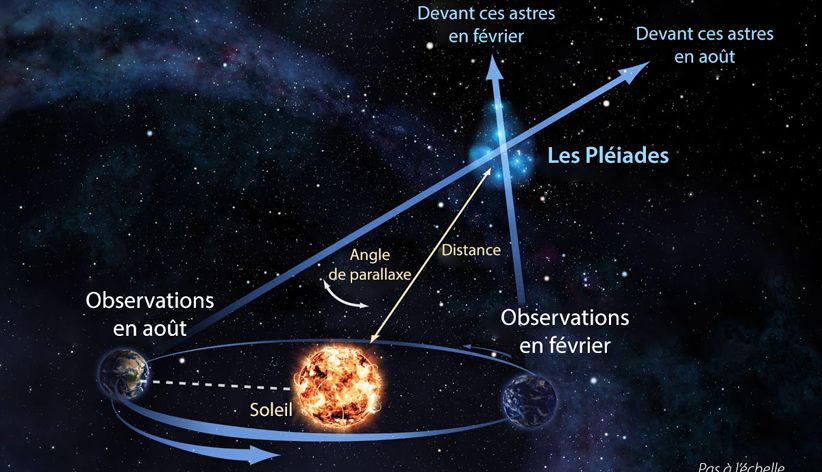
In reality, this very slight movement is solely due to the Earth's movement in its orbit around the Sun, like when you travel by train and see the landscape "go by." This apparent movement is a boon for astronomers: however tiny it may be, it allows them to measure the distance to nearby stars.
To understand this, imagine you're walking in the countryside and you spot a tree in the distance against an even more distant landscape. How do you determine its distance?
It's easy: simply move a little and measure the apparent change in the tree's position. To do this, let's use a compass. Let's assume that initially, the tree is pointing in the direction of the magnetic needle, that is, due North. If we move 50 meters west, the tree will no longer be aligned with the needle, but will have moved away from it by a certain angle.
This angle gives its apparent change in position. Knowing our own displacement and measuring this angle, we can obtain, with a simple division, the distance between us and the tree.
The same method applies to nearby stars.
However, in this case, it is the Earth that travels along its orbit around the Sun. The tree is the nearby star against the backdrop of distant stars. Astronomers then take measurements at six-month intervals. In this time, the Earth, the wanderer, has traveled half its orbit and finds itself at the opposite end of its orbit from its initial position relative to the Sun.
The apparent displacement of the star at six-month intervals is measured as an extremely small angle. Half of this angle is the star's parallax. By measuring it and knowing the radius of Earth's orbit, 150 million kilometers, astronomers can determine the distance between us and the star.
If the star is too far away (more than 1,000 light-years), no apparent movement is measurable. Astronomers then use another method.
It's easy: simply move a little and measure the apparent change in the tree's position. To do this, let's use a compass. Let's assume that initially, the tree is pointing in the direction of the magnetic needle, that is, due North. If we move 50 meters west, the tree will no longer be aligned with the needle, but will have moved away from it by a certain angle.
This angle gives its apparent change in position. Knowing our own displacement and measuring this angle, we can obtain, with a simple division, the distance between us and the tree.
The same method applies to nearby stars.
However, in this case, it is the Earth that travels along its orbit around the Sun. The tree is the nearby star against the backdrop of distant stars. Astronomers then take measurements at six-month intervals. In this time, the Earth, the wanderer, has traveled half its orbit and finds itself at the opposite end of its orbit from its initial position relative to the Sun.
The apparent displacement of the star at six-month intervals is measured as an extremely small angle. Half of this angle is the star's parallax. By measuring it and knowing the radius of Earth's orbit, 150 million kilometers, astronomers can determine the distance between us and the star.
If the star is too far away (more than 1,000 light-years), no apparent movement is measurable. Astronomers then use another method.
So, what might have seemed completely crazy at the beginning of this text—measuring the distance to stars—should now bring back memories of middle school. Think back: in geometry books, a chapter dealt with the trigonometric properties of a right triangle: an adjacent side (Earth-Sun distance), the cosine of an angle, and the hypotenuse (Earth-Star distance).
Since when have we been able to calculate these distances? Due to the limitations of telescopes' power and precision, the first accurate calculation of a star's parallax dates back less than two centuries: in 1838, the German astronomer Friedrich Bessel succeeded in measuring the parallax of star 61 in the constellation Cygnus. He deduced a distance of approximately 11 light-years. Considering the technology of the time, this was a remarkable achievement, as the star's angle of displacement between the two measurements barely exceeded one ten-thousandth of a degree.
Today, mapping the sky and calculating the distances to stars is entrusted to satellites, particularly Hipparcos, which specializes in measuring long stellar distances. A quick reminder: the distance to stars is measured in light-years. This is the distance that light travels in one year. Given that light travels at an approximate speed of 300,000 km per second, this represents 10 trillion km.
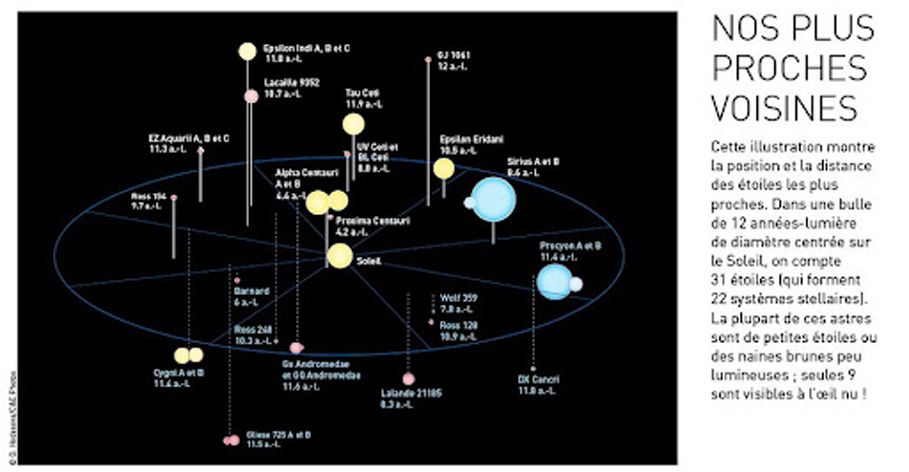
The closest star to our solar system is Proxima Centauri, in the constellation Centaurus. It is 4.3 light-years away. Polaris (the North Star) is 440 light-years away.
Visible in our evening sky until mid-May, the brightest of all stars is Sirius: 8.9 light-years away.
For reference, our Sun is 150 million km away, which represents only 8 minutes and 23 seconds in light-time.
Since when have we been able to calculate these distances? Due to the limitations of telescopes' power and precision, the first accurate calculation of a star's parallax dates back less than two centuries: in 1838, the German astronomer Friedrich Bessel succeeded in measuring the parallax of star 61 in the constellation Cygnus. He deduced a distance of approximately 11 light-years. Considering the technology of the time, this was a remarkable achievement, as the star's angle of displacement between the two measurements barely exceeded one ten-thousandth of a degree.
Today, mapping the sky and calculating the distances to stars is entrusted to satellites, particularly Hipparcos, which specializes in measuring long stellar distances. A quick reminder: the distance to stars is measured in light-years. This is the distance that light travels in one year. Given that light travels at an approximate speed of 300,000 km per second, this represents 10 trillion km.
The closest star to our solar system is Proxima Centauri, in the constellation Centaurus. It is 4.3 light-years away. Polaris (the North Star) is 440 light-years away.
Visible in our evening sky until mid-May, the brightest of all stars is Sirius: 8.9 light-years away.
For reference, our Sun is 150 million km away, which represents only 8 minutes and 23 seconds in light-time.

Upcoming Events
This section informs you about upcoming events in the fields of pure astronomy and space exploration.
Artemis 2 Launch to the Moon: Date of Arrival : April 1. To be continued. Normally, when this article is published, Artemis 2 will be orbiting the Moon.
Astronomical Events
May 7 and 8: Sunset under the Arc de Triomphe from the Place de la Concorde.
May 9, 10, and 11: Sunset under the Arc de Triomphe from the Champs-Élysées roundabout.
June 21: Summer Solstice.
July 31, August 1, 2, and 3: Sunset under the Arc de Triomphe from the Champs-Élysées roundabout.
August 3, 4, and 5: Sunset under the Arc de Triomphe from the Place de la Concorde.
August 12: Total solar eclipse, visible in its partial phase in mainland France.
Perseid meteor shower.
August 28: Partial lunar eclipse in mainland France.
September 14: Venus appears behind the Moon.
September 23: Autumnal equinox.
December 21: Winter solstice.
Ursid meteor shower.
Space exploration
ISS: French astronaut Sophie Adenot joined the crew aboard the ISS.
She became the 11th French astronaut and the second woman, the first being Claudie Aigneré.